
Driving for Uber or Lyft? What you should know about the ADA
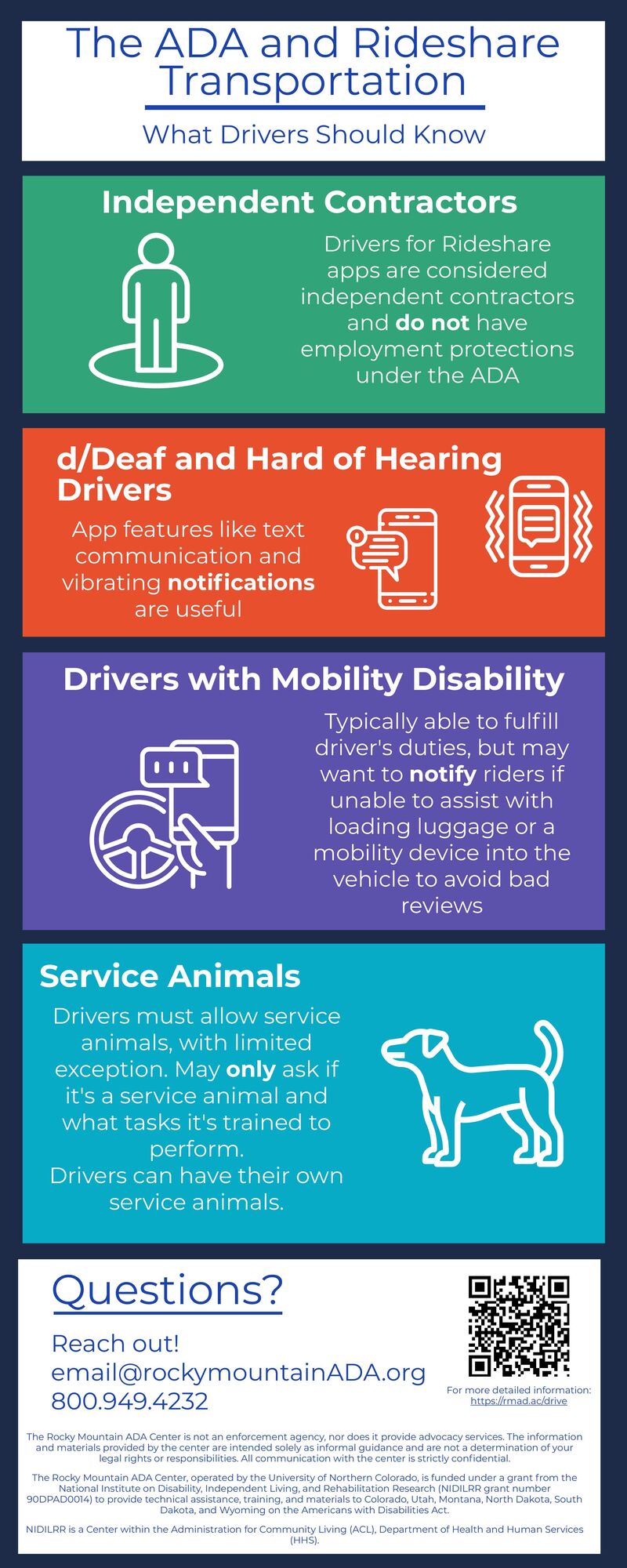
The ADA and Rideshare Transportation: What Drivers Should Know
Under the ADA, public and private transportation must provide accessible services for riders with disabilities. We will talk about issues specific to rideshare apps for drivers with disabilities.
Uber and Lyft
Uber and Lyft are two of the most common rideshare apps in the United States. Uber and Lyft self-label as technology companies and claim that they’re not transportation providers under the ADA. Courts generally disagree and say the ADA does apply to rideshare transportation services, but there is no national precedent yet to settle the argument.
Independent Contractors or Employees?
Drivers for rideshare companies are generally considered independent contractors, not employees. This matters because an employee of a large company will have rights under Title I of the ADA if they live with a disability whereas an independent contractor will not. However, drivers may adjust their work schedule themselves for their disability-related needs, if it doesn’t impact their responsibilities as a driver.
Example: A driver who is not able to sit for long periods of time can self-regulate their schedule so that they have breaks to stretch their legs and walk around. These breaks would be unpaid and could reduce that driver’s income-generating driving time.
Drivers with mobility disabilities may not be entitled to any kind of reasonable accommodation to help them perform their essential job responsibilities, like helping load luggage or other people’s mobility devices.
Drivers with Disabilities
Uber claims “hundreds of thousands of drivers with disabilities earn with Uber… anyone with a valid driver’s license is eligible to sign up to drive." The accessible features within each app are especially useful to people who are deaf or hard of hearing who want to work as drivers. The app provides flashing trip requests, text-only messaging, and other features that allow drivers with a hearing disability to work. Uber states that thousands of drivers who are deaf or hard of hearing drive for the company.
Drivers who use mobility devices could also work for Uber or Lyft, since many rides do not require a driver to exit the vehicle, but understand that some passengers may need help with luggage or their own mobility devices. Be aware that it’s possible that a driver with disabilities who receives enough negative reviews based on their inability to help a passenger load luggage may be discontinued from driving for Uber.
Drivers who have their own service animals are entitled to drive with them. Lyft recommends that drivers give riders advance notice of the presence of a service animal in case a rider has an allergy or discomfort with animals. Without reasonable job accommodations, a driver with a service animal could get a negative review from riders who are unaware the animal is a service animal or just dislike the presence of a service animal.
Accommodating Riders with Disabilities
All drivers of rideshare companies should know their passengers with disabilities have rights under the ADA. They have a right to travel with a mobility device or service animal. When signing up to work for the companies, Lyft and Uber drivers are provided limited training on how to accommodate passengers with disabilities. Lyft drivers sign an addendum where they agree they will not discriminate against riders with disabilities and will make reasonable modifications for riders who travel with service animals or folding wheelchairs.
Drivers who have wheelchair accessible vehicles can sign up to drive for Wheelchair Accessible Vehicle (WAV) programs to serve people who have larger mobility devices if they live in the cities where the program is provided. Uber WAV is available in Chicago, New York City, Philadelphia, and Washington, DC and Lyft’s “Wheelchair Rides” are in Boston, Chicago, Dallas, Los Angeles, New York City, Philadelphia, Phoenix, Portland, San Francisco and Toronto, Canada.
In areas where WAV programs are available, drivers of inaccessible vehicles might think that people with disabilities should use the WAV service, but drivers should understand that they are still required to transport people with disabilities if they are able to. You can’t force someone to request a WAV if their mobility device can fit into a normal car or SUV.
Drivers for Lyft and Uber should know that they are required by law and company policy to accept riders with service animals. They cannot refuse a ride or charge a cleaning fee because someone uses a service animal. Lyft states that a driver could face immediate deactivation if they improperly refuse a rider with a service animal.
Drivers may ask only two questions regarding service animals:
- Is this animal a service animal?
- What task is this animal trained to perform?
The driver should not ask about the disability of the passenger or anything more than these two questions.
A trainable task directly related to the passenger’s disability must be part of their answer. Providing “comfort” or “support” simply by being there is not a trainable task. The animal must be under the control of its handler at all times and is not entitled to sit on vehicle seats. The animal should be allowed to sit on the floor of the vehicle or on the handler’s lap. Not adequately answering either question or the animal repeatedly displaying lack of control may be grounds to deny the animal on the trip. Lyft states that drivers may not refuse a service animal based on “allergies, religious objections, fear of service animals, or any other reason not expressly authorized by the ADA.”
For more information on the ADA, please reach out to our team (email@rockymountainada.org or 800-949-4232) and we’ll be happy to discuss what’s on your mind.
Credit
This report was compiled by Maeve Moynihan, J.D., University of Denver Sturm College of Law and Jill L. Bezyak, PhD, Professor, University of Northern Colorado, and condensed into a knowledge translation format by Chris Murphy, Rocky Mountain ADA Center.
Disclaimer
The Rocky Mountain ADA Center is not an enforcement agency, nor does it provide advocacy services. The information and materials provided by the center are intended solely as informal guidance and are not a determination of your legal rights or responsibilities. All communication with the center is strictly confidential.
The Rocky Mountain ADA Center, operated by the University of Northern Colorado, is funded under a grant from the National Institute on Disability, Independent Living, and Rehabilitation Research (NIDILRR grant number 90DPAD0014) to provide technical assistance, training, and materials to Colorado, Utah, Montana, North Dakota, South Dakota, and Wyoming on the Americans with Disabilities Act.
NIDILRR is a Center within the Administration for Community Living (ACL), Department of Health and Human Services (HHS).