
ADA and Rideshare for Riders
The ADA and Transportation
Under Titles II and III of the ADA, publicly and privately operated transportation entities that serve the public must provide accessible services for riders with disabilities, including where a public entity contracts with a private entity.
“Private entities that are primarily in the business of transporting people and whose business affects commerce” are considered subject to Title III of the ADA, but Uber and Lyft do not categorize themselves as transportation providers. Instead, they self-label as technology companies. Courts have disagreed with this and consider Uber and Lyft to meet the definition of a transportation provider. This specific issue has not been addressed on a national level.
Riders
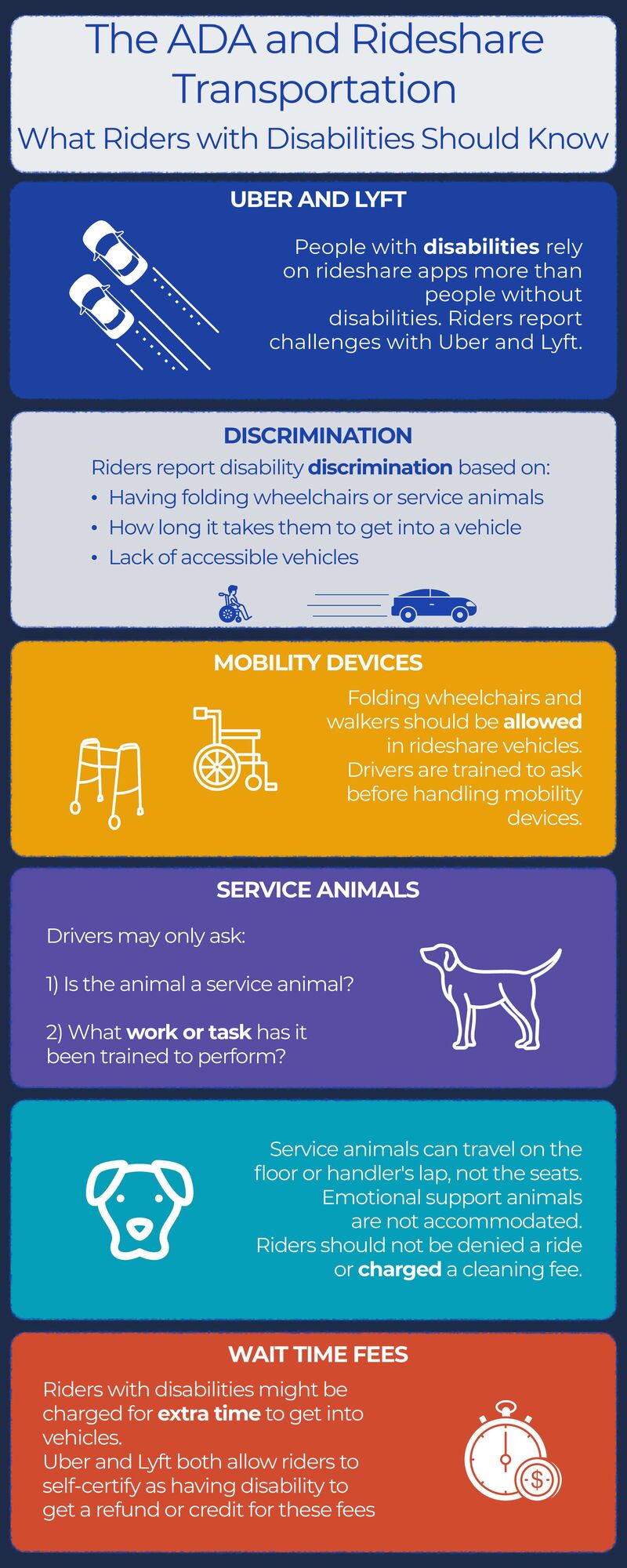
People with disabilities rely on rideshare apps more than people without disabilities. Riders report challenges with Uber and Lyft related to drivers’ failure to accommodate a rider’s disability.
Riders report disability discrimination based on:
- Use of folding wheelchairs, and service animals,
- How long it takes them to get into an Uber or Lyft vehicle,
- Lack of accessible vehicles for larger mobility devices.
Wheelchair Accessible Services
In 2020, Lyft settled a case in which they were sued by riders with foldable wheelchairs or walkers for discrimination. They claimed that Lyft drivers refused rides on multiple occasions because of their wheelchairs. The settlement ordered Lyft to revise its mobility device policies, communicate these policies to drivers quarterly, and provide an educational video for drivers on how to accommodate mobility devices. Lyft stated that it would create a complaint procedure for riders to report when drivers discriminate against them based on a mobility device.
In another case, three motorized wheelchairs users sued Uber under the ADA in California. They argued that Uber choosing to not offer wheelchair accessible vehicles (UberWAV) in their cities was discriminatory. UberWAV is a program specific to the needs of mobility devices that are too large or heavy to transport in non-specialized vehicles. They claimed that Uber effectively screened out riders with mobility disabilities from enjoying particular transportation services. Uber argued that providing UberWAV in additional cities would constitute a fundamental alteration to the company’s services, which the judge rejected.
Uber first argued that the ADA did not apply because it is a technology company, not a transportation company, which the judge rejected.
The wheelchair users argued that providing UberWAV in their cities was an appropriate reasonable modification to accommodate their disability-related needs. Uber argued that the request was not a potential reasonable modification under the ADA, which the judge also rejected.
Uber then argued that even if the request was a proper reasonable modification request, it was still unreasonable, which the judge agreed with. The judge considered the cost, feasibility, and other factors, then concluded that the plaintiffs did not provide enough evidence to demonstrate that bringing UberWAV to their home cities was feasible.
Practically speaking, these decisions mean that riders are unlikely to be able to require Uber or Lyft to develop wheelchair accessible services in particular cities under the theory of reasonable modification.
Complainants lost a similar case in a class action lawsuit against Lyft in New York in 2024. A federal judge concluded that Lyft did not violate the ADA by not offering its’ WAV services in the region where plaintiffs lived. The lawsuit argued that Lyft didn’t provide reasonable modifications and failed to remove transportation barriers in existing vehicles under the ADA. The court determined that plaintiffs’ desire for Lyft to expand its services was not a reasonable modification request. It instead concluded it would alter Lyft’s services, which the ADA does not require.
Contesting In-App Waiting Time Fees
The U.S. Department of Justice sued Uber in 2021 for disability discrimination rooted in the company’s wait time fees. At the time, when an Uber driver arrived, the company required a rider to get into the car within two minutes. If more than two minutes passed, the app began collecting fees based on how long the driver had to wait for the rider to get into the vehicle. It did not account for if the rider took longer to enter a vehicle because they had a disability or not. Lyft imposed similar fees for long wait times. As a result of the lawsuit, Uber allowed riders to self-certify that they had a disability and could request a refund for any wait time fees they were charged. Lyft offers a similar refund service.
Accommodating Service Animals
Riders who use service animals report frequent problems with rideshare apps. Riders frequently have drivers refuse to allow their service dogs in the vehicle.
Uber and Lyft charge a fee if a rider requests a trip and does not show up for a ride within two to five minutes of the driver’s arrival. A woman named Suzette May, who is blind, has had drivers wait for a full five minutes to trigger the app to automatically consider the rider a no-show, and then tell her they are will not allow her service dog in the vehicle. Both Uber and Lyft have policies allowing service animals but still experience discrimination because of their service animals.
Uber and Lyft require users to agree to an arbitration provision when users sign up for the apps. This requires users to waive their rights to a jury trial and instead resolve disputes outside of court. Riders can get relief through this arbitration process. For example, a California resident received over $324,000 in damages and plus attorney fees after Uber drivers had refused her service dog several times. The National Federation of the Blind also reached a settlement with Uber and Lyft based on discrimination related to service animals.
Uber and Lyft’s Attempts to Improve Accessibility
Uber and Lyft have made various changes to their services to better accommodate people with disabilities by providing accessible vehicles, in-app accessibility, and updated service animal policies.
Wheelchair Accessible Vehicle Programs (WAV)
Uber and Lyft require drivers to allow riders to bring foldable wheelchairs, walkers, and other mobility devices into vehicles during rides.Both Uber and Lyft have created WAV ride programs that accommodate motorized wheelchairs; however, these services are only offered in select locations.
WAV program vehicles must accommodate a motorized or fixed-frame wheelchair or larger non-foldable mobility device. WAV vehicles typically offer ramps, lifts, and securement equipment. Uber and Lyft offer WAV services at the same payment rate for riders as non-WAV rides.
According to Uber, UberWAV vehicles have completed a third-party service and safety certification.
Uber WAV is only available in Chicago, New York City, Philadelphia, and Washington, DC. Riders with UberWAV may bring as many companions as there are seats with seatbelts in the car, just as riders in other Uber vehicles may. Riders do not need to pay for additional companions. To request a WAV ride, a rider uses the Uber app and selects “WAV” when requesting a ride. Drivers are otherwise only trained to “ask before handling wheelchairs.”
Lyft created a similar WAV program called “Wheelchair Rides” and currently offers the service in Boston, Chicago, Dallas, Los Angeles, New York City, Philadelphia, Phoenix, Portland, San Francisco and Toronto, Canada.
In-App Accessibility
Some included features of the Uber and Lyft apps are helpful to riders with disabilities. For example, the apps allow riders and drivers to communicate either verbally or through text message, allowing riders with visual or auditory disabilities to use their preferred communication method. The apps provide visual and haptic notifications, so a rider knows when a ride is nearby and when it has arrived. The Uber app has a feature that allows riders to self-identify as blind, deaf, as having a visual or auditory impairment, or using a service animal.
Service Animals
Uber and Lyft have implemented service animal policies that reference both state and federal law regarding disability. Riders with disabilities are allowed to bring their service animals in both Uber and Lyft rides. Riders with service animals should only expect to answer two questions regarding their service animals: (1) is this animal required because of a disability; and (2) what work or task has the animal been trained to perform.Riders should not expect to provide any documentation for their service animal to a driver. Riders should also not expect an emotional support animal to be accommodated as a service animal. Riders using Uber have the option to self-identify as individuals with service animals in the app, allowing drivers advance notice. Lyft also offers riders the opportunity to voluntarily disclose if they have a service animal traveling with them.
If a rider who uses a service animal has a bad experience with Uber or Lyft, they may file a complaint with either company. The complaint might allow a rider to get a refund for the ride or credit with the company. A complaint might also lead to deactivating a driver’s profile and not allowing that driver from working for the company. Uber states that any rider that has issues with ride cancellations, harassment, and improper cleaning fees related to service animals may report a complaint. Despite policies stating that drivers are subject to ADA requirements, riders with disabilities still report ride cancellations, cleaning fees, and other problems.
Conclusion
Much of the law involving Uber, Lyft, and the ADA is unsettled. Despite attempts to make their services more accessible, riders with disabilities continue to report discrimination and challenges in using the apps. Approximately 15 states and Washington, D.C. have expanded their paratransit programs by using a rideshare company that is specifically tailored to providing services for people with disabilities, called Uzurv. There are promising legal arguments to demonstrate that both Uber and Lyft are subject to the ADA, and that riders and drivers are entitled to protection from disability discrimination.
Credit
This report was compiled by Maeve Moynihan, J.D., University of Denver Sturm College of Law and Jill L. Bezyak, PhD, Professor, University of Northern Colorado, and condensed into a knowledge translation format by Chris Murphy, Rocky Mountain ADA Center.